Tips
How to remodel your pharmacy without closing to the public
tips

Share this post
Artificial Intelligence is transforming the healthcare sector, creating opportunities to improve operational efficiency, personalise services and optimise the management of pharmacies and clinics. But its impact goes far beyond software. It is also redefining how healthcare spaces are planned, organised and used.
Technological development has long been a driving force in healthcare. From digital administration to advanced diagnostic equipment, pharmacies and clinics have continuously adapted to new tools and working methods.
Today, Artificial Intelligence (AI) represents another significant stage in this evolution. Its ability to analyse large volumes of information, identify patterns, automate processes and support decisions is opening opportunities that were once far removed from the daily operations of healthcare facilities.
However, adopting technology should never be considered an objective in itself. The challenge lies in integrating solutions safely, efficiently and in ways that respond to the needs of healthcare professionals and patients.
For pharmacy owners and clinic managers, this means considering not only which systems to implement, but also how their physical environments should evolve.

Artificial Intelligence encompasses technologies capable of performing tasks such as recognising patterns, interpreting information, identifying trends and generating recommendations.
In healthcare, these technologies can support administrative management, operational analysis, clinical decision-making and improvements in the patient experience.
It is essential, however, to distinguish between applications already used in specific environments and those still under development or requiring further scientific and regulatory validation.
Implementing AI does not necessarily require complex systems or substantial investments. In many cases, transformation begins with tools integrated into existing management platforms.
The starting point should always be understanding which specific problems technology can help solve.
A pharmacy experiencing difficulties with inventory management has different requirements from a clinic seeking to reduce waiting times or improve appointment scheduling.
Innovation should begin by identifying needs, not by choosing technology.
Pharmacies must balance healthcare delivery, operational efficiency and financial sustainability.
Medication management, stock control, staff organisation, patient support and administrative processes represent a significant proportion of everyday activity.
AI can contribute to improving several of these areas.
Forecasting systems can analyse historical sales data, seasonal trends and other relevant variables to support purchasing and inventory decisions.
Certain product categories experience fluctuations linked to seasonal changes, health conditions or evolving consumer behaviour.
Identifying these patterns can help anticipate demand, reduce shortages and limit the accumulation of slow-moving products.
Nevertheless, predictions must be supported by professional judgement and the regulatory obligations associated with medicine availability.
Pharmacy teams dedicate considerable time to administrative activities, document management, ordering and information updates.
Automating selected processes can reduce operational workloads and allow a more efficient allocation of responsibilities.
The objective is not to replace healthcare professionals, but to free up time for activities requiring specialist knowledge and direct patient interaction.
This can be particularly valuable for pharmaceutical counselling, medication management and healthcare services.
AI can help interpret operational indicators and identify opportunities for improvement.
Data analysis may reveal peak periods, changes in demand and inefficiencies in specific processes.
These insights can support staffing decisions, resource allocation and commercial planning.
However, performance assessment should never focus exclusively on sales. Service quality, patient safety and appropriate pharmaceutical advice must remain central.
The patient experience begins before the consultation or service itself.
Appointment scheduling, waiting times, accessibility, privacy and the clarity of information all influence perceptions of care.
AI can help improve several stages of this journey when integrated into a broader service strategy.
Digital tools can facilitate access to administrative information, support requests and improve service organisation.
Automated systems may answer frequently asked questions about opening hours, available services or appointment procedures.
These applications must be distinguished from clinical or pharmaceutical advice, which requires professional assessment and accountability.
Personalisation must also respect privacy and data protection requirements.
Technology represents progress when it makes healthcare simpler, more accessible and more human.
Analysis of visitor patterns can help identify periods of high demand and support better resource planning.
In pharmacies, this information can contribute to staffing and counter organisation.
In clinics, it may improve scheduling, resource allocation and the identification of operational bottlenecks.
Reducing waiting times also depends on service duration, staff availability and the physical organisation of facilities.
Technology must therefore work alongside effective spatial planning.
In clinics, AI applications vary according to medical speciality, facility size and existing systems.
Potential uses include administrative management, appointment scheduling, documentation and selected clinical decision-support tools.
These applications have different levels of complexity and regulatory requirements.
Efficient scheduling must account for professional availability, expected procedure duration, equipment requirements and patient needs.
Analytical tools can identify demand patterns, missed appointments and periods of high occupancy.
This information can support better use of consultation rooms and reduce operational inefficiencies.
Document preparation, record organisation and administrative management require considerable staff time.
Certain AI tools can assist with drafting documents, structuring information and automating repetitive tasks.
Their use requires appropriate validation, access controls and safeguards for sensitive healthcare information.
AI is also being researched and used in specific contexts involving diagnostic assistance, medical imaging and clinical information analysis.
Such applications require scientific validation, professional supervision and compliance with applicable regulations.
AI-generated information must not be confused with an autonomous clinical decision.
Healthcare professionals remain responsible for evaluating individual circumstances and determining appropriate care.
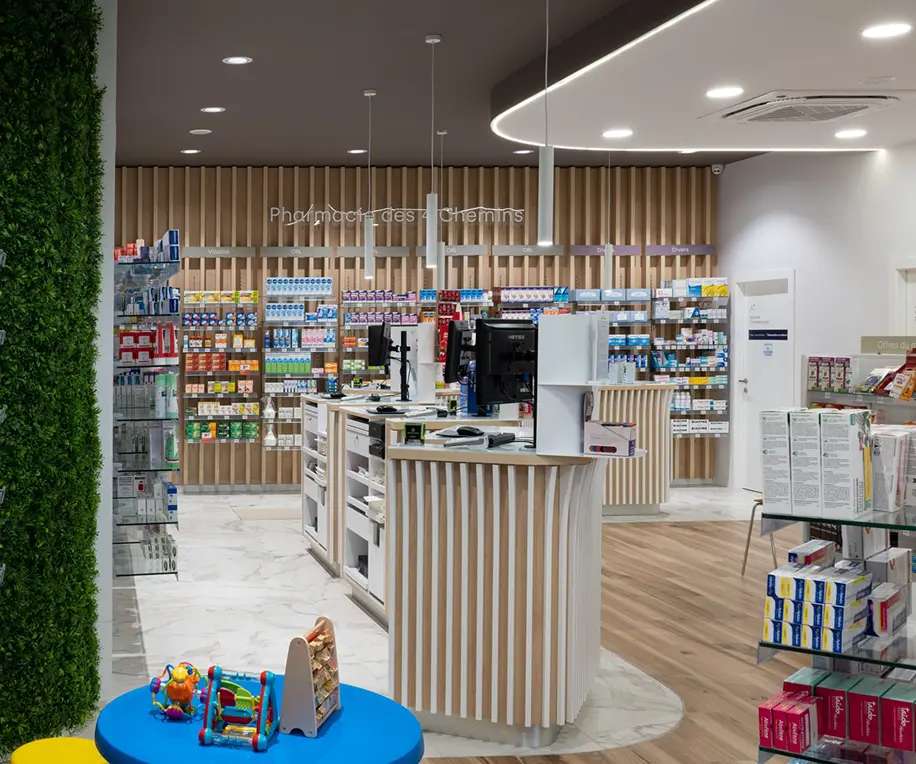
Digital transformation is creating new requirements for physical healthcare environments.
A pharmacy designed exclusively around traditional processes may face limitations when introducing new equipment, services or operational systems.
This is where architecture and design become strategic.
Modern pharmacies increasingly combine counter services, private consultations, healthcare services and administrative operations.
Digital integration can influence counter positioning, furniture layouts and the organisation of supporting areas.
For example, automated storage and dispensing systems may require different workflows from conventional storage arrangements.
Additional healthcare services may also require dedicated rooms offering privacy, comfort and suitable working conditions.
Efficient circulation is fundamental to pharmacy design.
Patient movements, staff routes and product handling should be considered together.
Operational data may help identify congestion points, frequently used areas and opportunities to improve circulation.
However, defining an effective layout still requires specialist knowledge of ergonomics, accessibility, safety and functionality.
Data can help explain how a space is used. Design transforms that knowledge into practical solutions.
Technological developments may require new equipment, connectivity, power supplies and communication systems.
Flexibility should therefore be considered from the earliest design stages.
Modular furniture, accessible infrastructure and adaptable layouts can simplify future changes.
This approach may reduce the need for extensive renovation when operational requirements evolve.
In clinics, the relationship between technology and physical space is equally important.
Digital systems, diagnostic equipment and new service models can influence the organisation of reception areas, waiting rooms, consultation rooms and internal circulation.
Reception is often the first point of physical contact between patients and a clinic.
Digital check-in, appointment confirmation and administrative automation can simplify certain procedures.
Nevertheless, reception continues to play a fundamental role in welcoming, guiding and assisting patients.
Its design must consider different user profiles, including people with reduced mobility or limited familiarity with digital tools.
Technology should improve access rather than create new barriers.
Consultation and treatment rooms must respond to the requirements of each medical speciality.
New equipment may introduce additional demands relating to electricity, connectivity, lighting, ventilation and furniture organisation.
Well-planned spaces should anticipate reasonable future adaptations without requiring unnecessary investment.
The increasing use of digital systems makes information protection and patient privacy even more important.
Screen visibility, acoustic insulation, equipment positioning and circulation should contribute to a secure environment.
Lighting, materials, acoustics and environmental comfort also remain essential to patient experience and staff wellbeing.
Technological innovation must be integrated without compromising these principles.
AI adoption should be approached as an organisational transformation rather than simply purchasing software.
Begin by analysing daily operations.
Identify time-consuming tasks, recurring difficulties and activities that could benefit from automation.
Healthcare professionals should be involved in this assessment because they understand how systems and spaces are actually used.
Technology should respond to measurable goals.
Reducing administrative workloads, improving scheduling, optimising inventory or supporting resource planning are examples of objectives that can be monitored.
Without clear goals, organisations risk investing in sophisticated but ineffective solutions.
Integration with existing management platforms and infrastructure is fundamental.
Disconnected solutions can duplicate tasks, increase costs and complicate workflows.
Interoperability, security and maintenance requirements should be evaluated before implementation.
Training is essential.
Professionals must understand the capabilities, limitations and validation requirements of the tools they use.
Technology improves efficiency only when it is properly integrated into daily operations.
New systems may affect equipment placement, workstations, storage and circulation.
When planning a renovation, extension or relocation, these requirements should be assessed during the design phase.
Coordinating technological and architectural decisions can prevent unnecessary future modifications.
Despite its potential, AI integration requires a responsible approach.
Healthcare information is particularly sensitive and subject to strict data protection requirements.
In the European Union, processing personal data must comply with the General Data Protection Regulation (GDPR), including principles relating to security, purpose limitation and data minimisation.
Certain AI applications may also fall within the scope of the EU Artificial Intelligence Act and medical device legislation.
Applicable obligations depend on the system's intended purpose, classification and use.
Reliability is another major consideration.
AI systems may produce inaccurate information, misinterpret specific circumstances or reflect limitations in their training data.
Human supervision, appropriate validation and clearly defined responsibilities are therefore essential.
In healthcare, innovation must always remain subordinate to patient safety and the quality of care.
The development of AI points towards greater integration between digital systems, equipment, operational processes and physical environments.
In pharmacies, this transformation may support more informed management, improved organisation and greater availability of professionals for patient counselling.
In clinics, it may contribute to better service coordination, resource planning and patient journeys.
However, benefits will vary according to facility size, services, available resources and the digital maturity of each organisation.
Flexibility will therefore become increasingly important.
Healthcare environments must respond to current needs without restricting future development.
Architecture and design will play a central role in ensuring that technological solutions are integrated coherently, efficiently and around the people who use them.
At Medd, we believe that pharmacy and clinic design must go beyond aesthetics.
Functional organisation, efficient circulation, ergonomics, comfort and patient experience are essential to creating spaces that respond to the demands of healthcare.
Technological development reinforces the importance of this approach.
A well-designed environment should accommodate new processes and equipment while maintaining service quality and appropriate working conditions.
AI can support decisions and identify opportunities for improvement, but it cannot replace the specialist knowledge required to translate operational needs into architectural solutions.
By bringing together strategy, architecture, design and functionality, healthcare spaces can be created with the capacity to evolve.
We believe the future of pharmacies and clinics will be shaped by an increasingly close relationship between technological innovation and human-centred care.
The healthcare spaces of tomorrow will not simply be smarter. They must also be more efficient, adaptable and human.
Artificial Intelligence is opening new possibilities for pharmacy and clinic management.
Process automation, data analysis and operational support can contribute to greater efficiency and improved patient experiences.
However, successful transformation requires an integrated perspective that considers people, processes, technology and physical environments.
For healthcare managers, preparing for the future means making decisions that support progress without compromising service quality.
At Medd, we develop architecture and design projects for pharmacies and clinics, combining functionality, identity and adaptability.
Are you planning to create, renovate or expand your pharmacy or clinic?
Discover our approach to healthcare space design and how we can help prepare your next project.
Count on a multidisciplinary team with extensive experience in developing construction and renovation projects. Count on Medd’s professionals to ensure the success of your project. Contact us today!
Find inspiration for your renovation projects. Follow us and stay up to date with the latest news.